
Start With a Lexington Residents Directory Question
There is no official master list of everyone in Lexington. The useful trail depends on what the record needs to establish. An address question starts with the County Property Search and its parcel card. A transaction question moves to the Register of Deeds. A defined court matter belongs with the Clerk or the trial index. Older names often belong at Lexington Main Library, where the South Carolina Room keeps newspapers, maps, census material, family histories, and reference directories. Each source records a limited fact, so a property owner, a party to a filing, and a historical notice should remain separately labeled.
Start with the narrowest reliable detail. A street, TMS number, deed book and page, case number, or newspaper date is better than trying to infer identity from a loose name match. The following order keeps a Lexington residents directory search tied to records that can be checked.
- Search the county property record by owner, street, TMS, or deed reference.
- Save the property location, legal description, and TMS before opening the map or deed trail.
- Use the appropriate custodian for a court, voter, vital, or municipal record.
- For an older household, ask Lexington Main staff for the relevant directory, newspaper, census, or microfilm run.
- When an online result ends, request a specific public record from the office that holds it.
Note: A record may be public without being a complete statement of who currently lives at an address.
Lexington Address Records by Parcel
The county property card is the most practical current address starting point. Its official route accepts owner name, street name, tax map number, tax year, or book and page. For street work, the county instructs users to enter the street name without a number or suffix. A result can lead to its TMS card and Show Map, which connects the record to parcel geography. The card and tax guidance identify the legal description, property location, and TMS. They can also show owner-of-record and a supplied mailing address.
A mailing address is a contact field, not proof that the owner occupies the parcel or that every household member is shown. The Treasurer explains that notices go to the address on file, and the Assessor receives that address from a recorded deed or tax-discount application unless it is changed. Keep situs and mailing information separate when comparing records. For the full address-by-address route, use the Lexington by street directory.
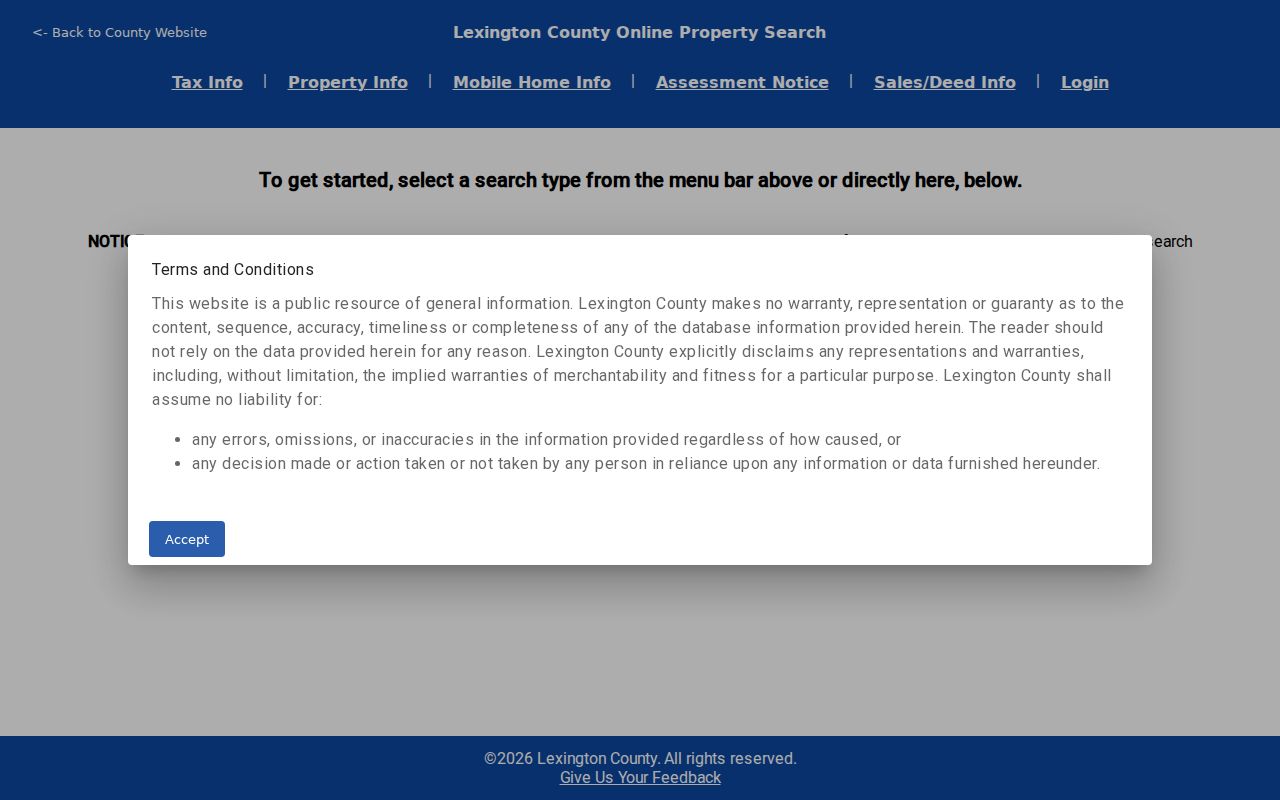
The Lexington County Property Tax-Data Search is the county’s disclaimer-first entry point.
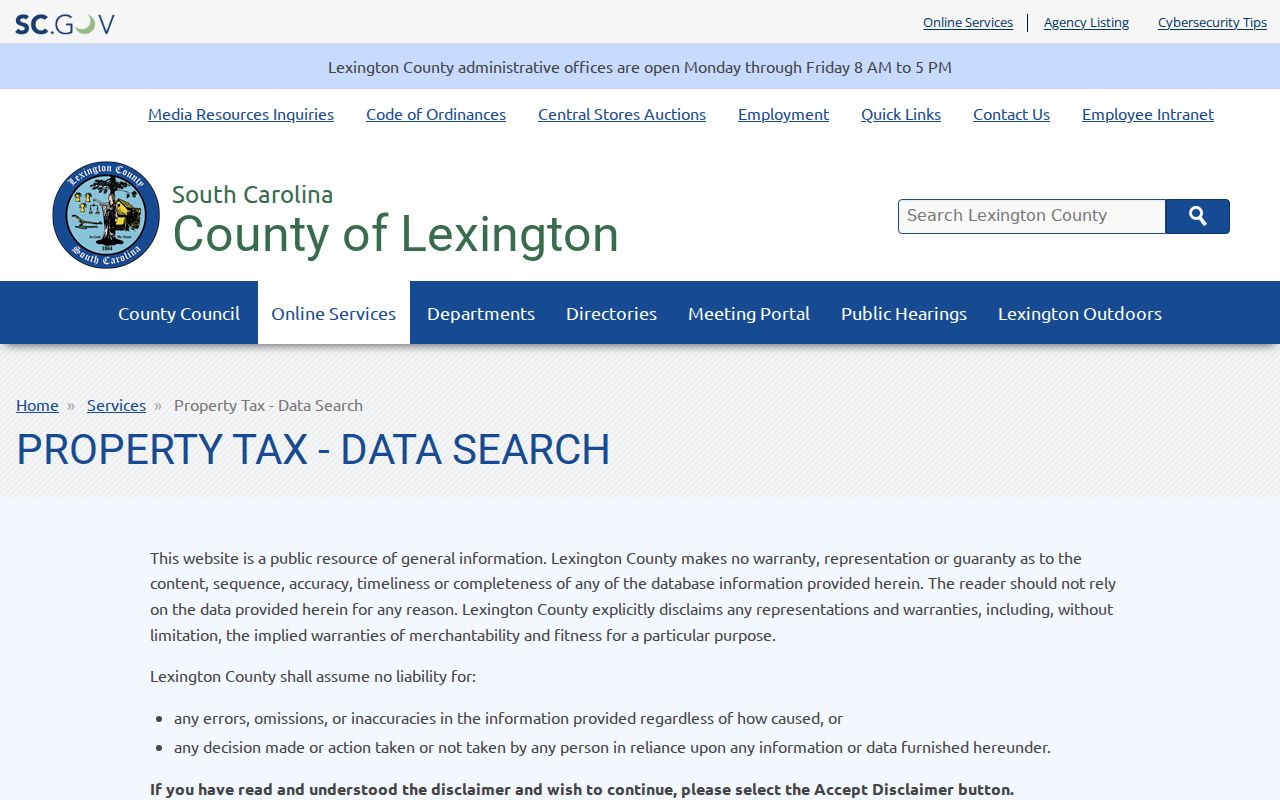
The live County Property Search supplies the address, owner, TMS, and deed paths needed to make a parcel query reproducible.
Lexington Resident Record Offices
Lexington is the county seat, but one office does not keep every type of record. The Assessor maintains ownership and tax mapping. The Register of Deeds preserves recorded land instruments. The Clerk maintains Circuit Court, General Sessions, and Family Court records, while Probate has estate and marriage-license roles. The elections office manages local voter-registration access. DPH is the state certificate custodian. The library and State Archives supply the historic shelf. Use the office tied to the record rather than treating a name hit as a universal identity answer.
Lexington County Assessor
212 South Lake Drive, Suite 201
Lexington, SC 29072
(803) 785-8190
Lexington County Register of Deeds
212 S. Lake Drive, Suite 301
Lexington, SC 29072
(803) 785-8168
Registration and Elections
605 W. Main Street, Suite C
Lexington, SC 29072
(803) 785-8361
For a record that is not available through a portal, the office counter, telephone contact, or a focused request is often the next access channel. A document, certification, and private or restricted material may each have different rules.
Lexington Property Search Fields
The property system gives several paths into the same parcel record. Begin with the exact field already in hand, then preserve the TMS and legal description as the record trail moves to deeds or maps. The form’s field layout is more reliable than guessing which version of a street or owner name a search engine might favor. Returned rows can display tax year, TMS or mobile-home decal, owner, location, use, acres, deed, and sale date, with a CSV download available.
| County search field | Use in a Lexington record trail | Important limit |
|---|---|---|
| Property Owner | Search in last-name, first-name or business format. | An owner record does not list all occupants. |
| Property Location | Locate an address or street. | The form has no ZIP filter. |
| Tax Map | Open a known parcel by TMS. | Verify its legal description before tracing deeds. |
| Deed Book and Page | Follow a recorded sale or instrument reference. | Both fields are used as a pair. |
| Tax Year | Reach an historic or current tax route. | It does not establish present occupancy. |
Those fields describe assessed parcels and recorded ownership context. They should not be republished as a list of households. The County GIS is a spatial companion that can confirm a parcel outline and street frontage, but its geometry also is not a resident list.
- Parcel
- A defined tract represented by the county map and TMS system.
- TMS
- The ten-digit tax map number used to identify and locate a Lexington County property.
- Situs
- The physical property location, distinct from a tax-contact mailing address.
- Index
- A finding tool that points to a record rather than replacing the record itself.
Lexington Deed Index Account Access
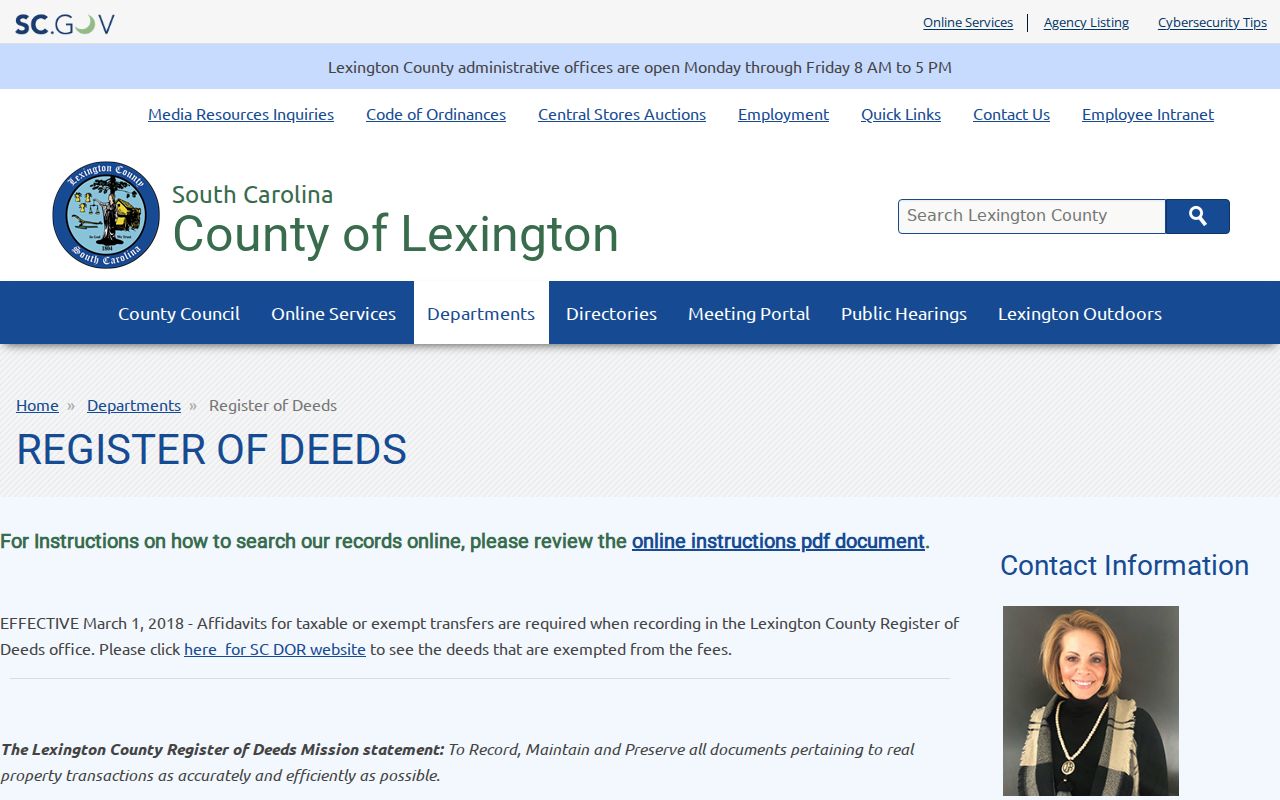
The Lexington County Register of Deeds records deeds, mortgages, plats, liens, and related land instruments. Its current Official Records Search requires free registration before search, view, and print. The account form requests first name, last name, email, and a password of at least ten characters. Research did not open the account-only search filters, so a fixed current dropdown list should not be assumed.
County information reports online data from August 1, 1984 to the present and images from January 1, 1997 to the present. An older instrument can require the Register of Deeds counter or its books and indexes. The documented name, firm, book/page, and legal-description routes explain why the property card’s TMS and legal description matter. A recorded result can identify parties, instrument type and date, recording placement, and legal description. It does not show every person who used an address.
The Official Records Search registration screen makes the free-account gate clear.
Note: County information reports 50-cent office copies, while certification and recording charges should be confirmed with the Register of Deeds.
Current Lexington Residents Directory Sources
Current sources answer different questions. The property roll can identify an owner of record and parcel fields. A deed index identifies parties to a recorded transaction. Court and voter records use their own access rules. Public business and license sources can establish a narrow affiliation, not a residence. The distinction keeps a Lexington residents directory search focused and prevents a record from saying more than it does.
| Lexington source | Recorded fact | Keeper | Access route |
|---|---|---|---|
| Property and tax record | Owner, situs, mailing field, TMS | County Assessor | Public property search, office, or phone |
| Recorded instruments | Grantor, grantee, legal description, date | Register of Deeds | Free registered-user portal or counter |
| Registration record | Registration and district context | County elections office | Inspection rules and self-service route differ |
| Court index | Party, case, docket action, TMS context | Clerk and Judicial Branch | Index or courthouse counter |
| Business or license record | Public affiliation or credential status | SOS, LLR, or Town | Separate official systems |
Official records are generally more specific about the fact they hold. A commercial people-search category may combine stale or mismatched material. It is not a substitute for the custodian’s current record, particularly when the question turns on a parcel, case, or certificate.
Lexington Voter Records Have Two Routes
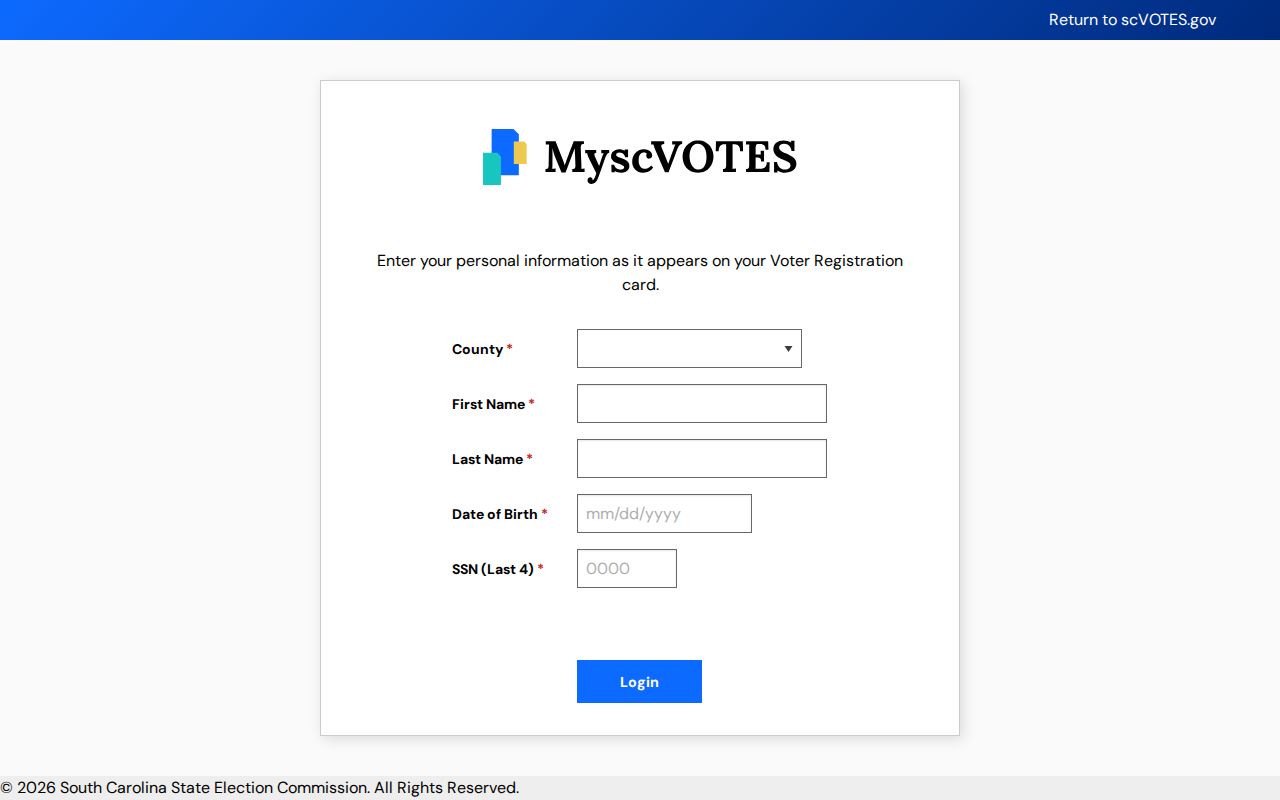
South Carolina separates personal self-service from public inspection and list access. MySCVotes voter information asks for county, first name, last name, date of birth, and last four digits of a Social Security number, using the information printed on a registration card. It is for a voter to access matching information, not a general stranger-name search. The County Board of Voter Registration and Elections is the right local contact for inspection, corrections, and current district questions.
Under S.C. Code §7-5-410, official registration records are available for inspection by a citizen at the county board or clerk, while Social Security numbers remain excluded. A status record can help with registration or district context. It never reveals ballot choices. Statewide list sales also have purchaser rules and are not a shortcut around the self-service screen.
The county, name, birth-date, and last-four login illustrates why this channel is not an open browse tool.
Verify a Lexington Resident Across Records
A same-name match needs another independent, non-sensitive anchor. Compare a full or variant name with a timeframe, TMS or legal description, court case number, business registered office, or newspaper source and page. Record spellings exactly. Do not ask a clerk to decide whether two similar names are the same person. If the index does not supply enough context, stop at the source and seek the document or a custodian explanation.
For a one-person question, move from a property card or recorded instrument to GIS confirmation, then use a court index only when a defined case trail fits. An older family question may use the obituary index, newspaper microfilm, released census material, SCDAH records, and confirmed church or cemetery holdings. The more detailed name-first workflow appears in the Lexington resident lookup.
Lexington FOIA Beyond Web Searches
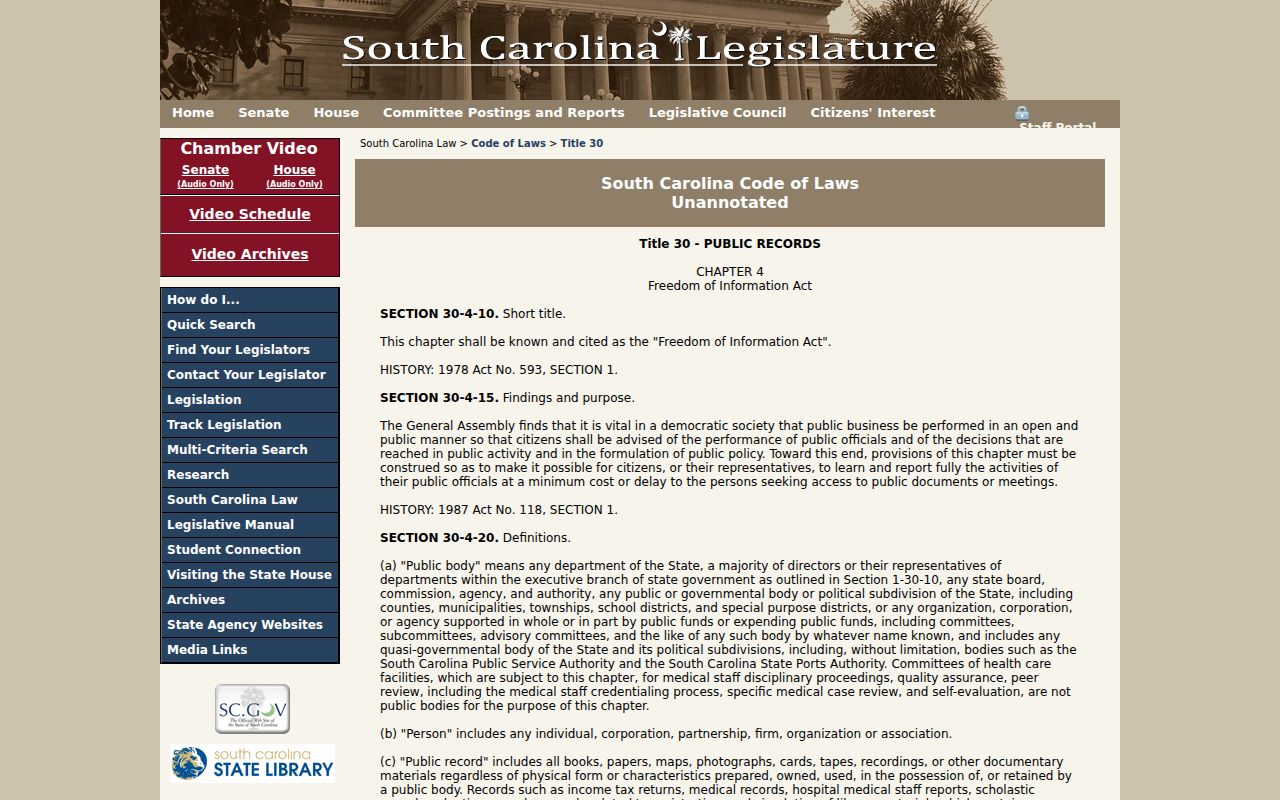
The South Carolina Freedom of Information Act is the route for a defined Town or County public record that is not posted online. It does not require a custodian to create a record or infer a person from scattered files. A good request names the record, date range, address, case number, or TMS and asks to inspect or receive an existing electronic copy when available. Under Title 30, Chapter 4, an agency determines availability within 10 business days for records under 24 months old, or 20 business days for older records. Production follows within 30 or 35 calendar days after that determination, subject to a permitted deposit.
The County FOIA form lists $0.25 per copied page, $0.50 per digitized page, $5 for CD or USB media, and $4 per fifteen minutes of research, waived below fifteen minutes, with a potential 25 percent nonrefundable deposit. Town fees differ, so a request should go to the custodian that owns the record.
The South Carolina FOIA code provides the state access rule behind a focused Lexington request.
Court and Vital Lexington Record Limits
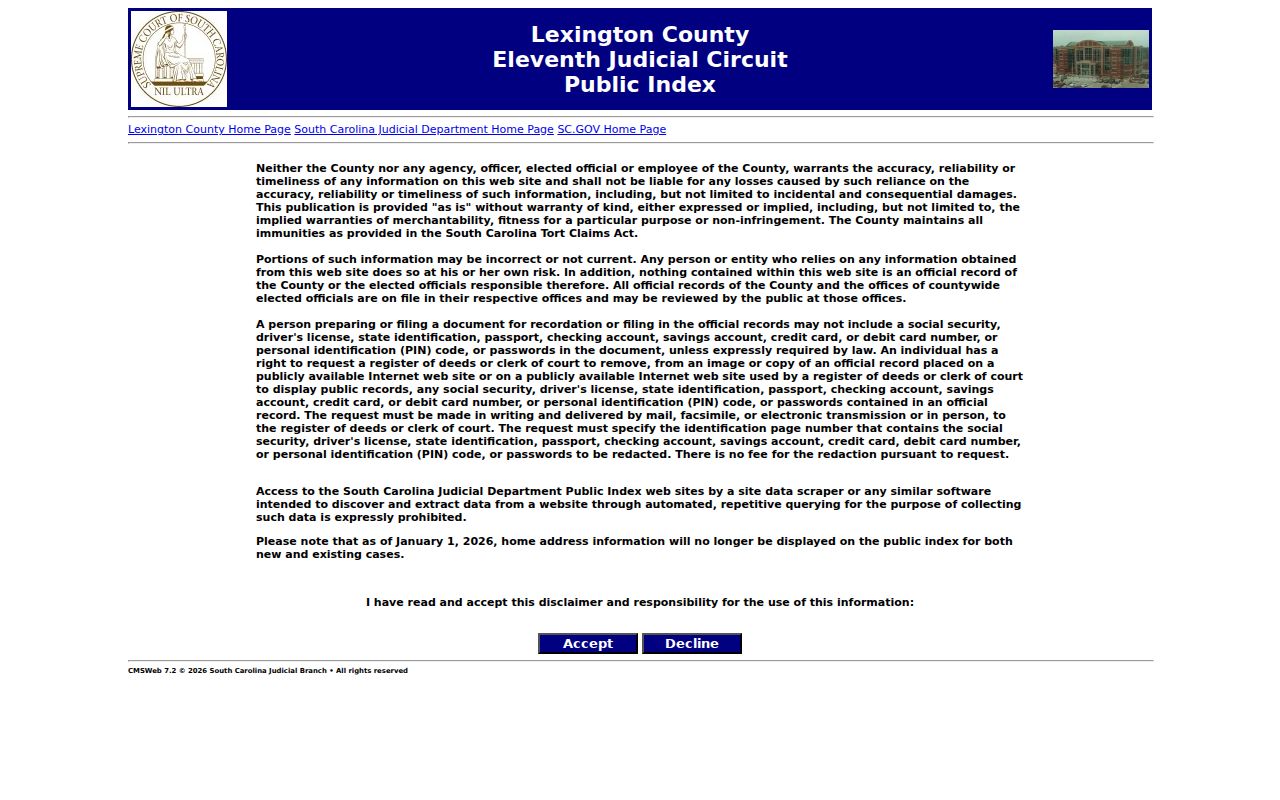
The 11th Judicial Circuit’s Trial Court Public Index supports searches by case number, party or business name, action and date range, and tax map number. During research, the Lexington endpoint returned a server-side error. The published court guide still confirms the field structure, but an index entry remains a case lead, not proof of identity. The Lexington County Clerk at the courthouse is the fallback for certified copies, older unscanned files, and matters whose display is incomplete. Sealed, confidential, and expunged materials do not become open because a name is searched.
DPH vital records serve a different purpose. Birth records become public after 100 years and death records after 50 years as noncertified copies; earlier certificates have statutory eligibility rules. Marriage records from July 1950 through December 2023 use the DPH channel, with Probate Court serving earlier or later license requests. Vital material records an event. It is not a present-location directory.
The Lexington Trial Court Public Index screenshot shows the court’s official entry point.
Lexington Resident History at the Library
When current portals cannot answer an older question, Lexington Main Library’s South Carolina Room is the local fallback. At 5440 Augusta Road, its noncirculating resources include reference books, maps, local obituary indexes, microfilmed newspapers, census material, historical papers, family histories, military records, and photographs. Staff can point a researcher to a relevant run or format rather than promising every name appears online. Ancestry Library Edition is available inside the library, while HeritageQuest can be used from home with a library card.
The online obituary index has a required last-name field plus optional first name or nickname and year of death. A result can show full name, death and birth dates, age or place, source code, publication date, and page. It points back to the named newspaper issue. Its Dispatch-News coverage has a documented gap from February 24, 1944 through October 4, 1962, so a negative result in that window needs a library newspaper check rather than a conclusion.
Note: A library index entry is a lead to its cited source, not a substitute for the source itself.
Historical Lexington Residents Directory Shelf
Lexington Main holds physical, noncirculating city-directory runs rather than one continuous online series. Its catalog lists Town-including volumes for 1967; 1970 through 1984; 1985 through 1989; 1991 through 1996; 1998 through 2021; and 2023 through 2026. Cataloged gaps include 1968-69, 1990, 1997, and 2022. A cross-reference series lists selected holdings for 1979-86, 1988-94, and 1996-2003. These are useful household-research leads, but a particular volume must be opened before stating its entry codes or street arrangement.
Pair a selected directory year with a deed, obituary, newspaper, or released census record. The full shelf, index fields, and year-by-year tracing method are detailed in the Lexington city directories collection.
Lexington’s 1865 Deed Break
Historic property work in Lexington County has a hard boundary. In February 1865, advancing federal troops destroyed pre-1839 Clerk of Court records, including deeds and virtually all probate records. The State Archives says no county conveyances exist before 1839. That loss means no honest records trail can promise an unbroken prewar deed or probate chain.
SCDAH State Plats, online for 1784-1868, can supply a recipient, location, adjoining owner, deputy surveyor, waterway, road, or other land context. It is a bridge for a historic land story, not a modern parcel boundary or a statement of current residence. The State Archives also identifies later conveyance, mortgage, plat, tax, and assessment materials for the county.
Lexington ZIP and Town Boundaries
A Lexington mailing address, ZIP, Town limit, and county jurisdiction can point to different maps. County Addressing assigns new addresses in unincorporated areas, while municipalities assign them inside their limits. OneMap keeps separate mailing and situs address fields, including distinct ZIP fields. Before treating a postal name as proof of Town jurisdiction, check the parcel, its situs fields, and the relevant Town GIS or annexation material. A ZIP may narrow an address question, but the Property Search has no ZIP filter and the TMS or street route remains stronger for parcel work.
The Town’s rapid growth makes this distinction practical. Census context, older directory dates, a property-card tax year, and an annexation map may describe different points in time. Use the correct dated record for the question at hand.