
What a Lexington Resident Lookup Confirms
Lexington has no official master list of residents. Each official system answers a smaller question. The county property record can identify the owner of record, a situs address, a mailing address, a tax map number, and a legal description. It cannot establish that every person at a parcel lives there. A recorded instrument instead tracks a transaction party and land description. The court index identifies a party and case activity, but a shared name needs more checking. Voter, vital, library, business, and probate sources have their own rules. Label a finding by what its source actually records.
| Record | What It Confirms | Where | Access |
|---|---|---|---|
| County property and tax record | Owner of record, situs, mailing address, TMS, legal description | Lexington County Property Tax-Data Search | Public resource; ownership is not occupancy. |
| Recorded instrument | Grantor or grantee and a legal-description transaction | Lexington County Official Records Search | Free registration; online data begins 1984 and images begin 1997. |
| Voter record or list | Registration, address, district, and participation status | MySCVotes, county board, or state list process | Self-service screen is gated; full-list purchase has statutory limits. |
| Court index | Party, case, docket action, and possible TMS context | 11th Circuit Trial Court Public Index and Clerk | Same-name risk; sealed, expunged, or confidential material may not display. |
| Vital or historical notice | Documented event or an older name and date lead | SC DPH Vital Records or library obituary index | Certificates have eligibility rules; historic public periods apply. |
| License, business, or facility result | Public credential, affiliation, or inspection fact | SC LLR Licensee Lookup and state systems | Not a residential directory. |
Start with the record most closely tied to the question. An address question calls for the county property card, current deed reference, and GIS parcel. A case question calls for the trial index, Family Court portal, or a clerk request. An older family question may begin with the library’s obituary index, then its cited newspaper issue or microfilm. For a marriage or divorce, the event year determines whether DPH, Probate Court, or the Clerk is the custodian.
Start a Lexington Resident Lookup by Record
For a present address question, use the county property resource to anchor the search to a tax map number, also called a TMS. That identifier and the legal description are stronger match points than a surname alone. Compare the property card with the county GIS map and then the current Register of Deeds instrument if a transaction must be checked. The ROD web search is free after registration, but its reported online data start is August 1, 1984 and its image start is January 1, 1997. Earlier material may require a counter or archive route.
That sequence does not convert an owner name into a household list. A tax mailing field is a contact address. It may differ from the physical situs address, and neither field establishes every occupant. When the question instead concerns a dated Town record, request the specific address, date, project, or file from the correct office. No official Town Municipal Court name-search portal was verified, so a precise request to the court clerk is the documented path for a municipal case.
Street-wide research needs a different method. The Lexington by-street directory follows the address and parcel chain rather than trying to turn one person search into a list of a street’s households.
Verifying a Lexington Resident's Records
A Lexington resident lookup becomes more reliable when two independent, non-sensitive details point to the same record trail. Keep the spelling found in each system, including middle initials, suffixes, and former names when the source states them. Then compare a timeframe with a property TMS or legal description, a case number, a registered business office, or a newspaper publication page. A clerk can explain how a record system works or provide a copy. The clerk should not be asked to decide whether two people with the same name are one person.
- Begin with a defined fact, such as an address, a court case number, an event date, or a known professional credential. Record the full name and spelling shown by that source.
- For an address trail, obtain the property card and compare its TMS and legal description with the county GIS parcel. Check the ROD instrument only when a recorded transaction is relevant.
- Use the relevant index to test the same name and time period. Court searches can be narrowed by case number, party name, date activity, or TMS context. Historic obituary results should be checked against the cited issue.
- Stop when the available record lacks a reliable second anchor. Ask the custodian for the defined record or a certified copy when an official, authenticated copy is needed.
- Docket
- A docket is the court’s running list of actions and filings in one case. It is not proof that every listed party has been identified correctly.
- Index and image
- An index points to a record through searchable fields. An image is a view of the filed document, which may have separate access limits or redactions.
- Certified copy
- A certified copy is a custodian-issued copy authenticated for official use. A public portal screen or downloaded image is not the same thing.
Checking Lexington Resident Names in Court
Lexington County is in South Carolina’s 11th Judicial Circuit. The Trial Court Public Index Lexington endpoint is the official entry point for Circuit and related trial-court index work. It returned a server-side error during the documented research, so a live result screen was not assumed. The Judicial Branch’s official search guide confirms the controls below. Results still require careful comparison, especially for a common name, because a party name alone does not prove identity or a current address.
| Public Index field | Use documented by the court guide |
|---|---|
| Court Type and Court Agency | Optional jurisdiction or agency limiters. |
| Case Number | Direct route to a known case. |
| Last Name/Business, First Name, Middle, Suffix | Optional party or business-name search fields. |
| Party Type, Action Type, Date Type, and date range | Optional role and activity filters. |
| Tax Map Number From/Through | Optional property context that can connect a case to a TMS. |
| Name Search Option | Begins With or Contains, plus documented civil and cross-index controls. |
The Clerk of Court keeps General Sessions, Common Pleas, and Family Court records. Clerk and public-terminal access are the fallback for an older unscanned file, a copy question, or incomplete index display. Documents scanned or filed on or after April 14, 2014 are generally available, while clerks decide whether older records are scanned or published. The distinct Family Court public portal is another case and docket channel, but its dynamic public filter inventory was not verified. Sealed, confidential, and expunged matters remain outside ordinary public display.
See the official Family Court portal before treating a trial-index search as a full court search.
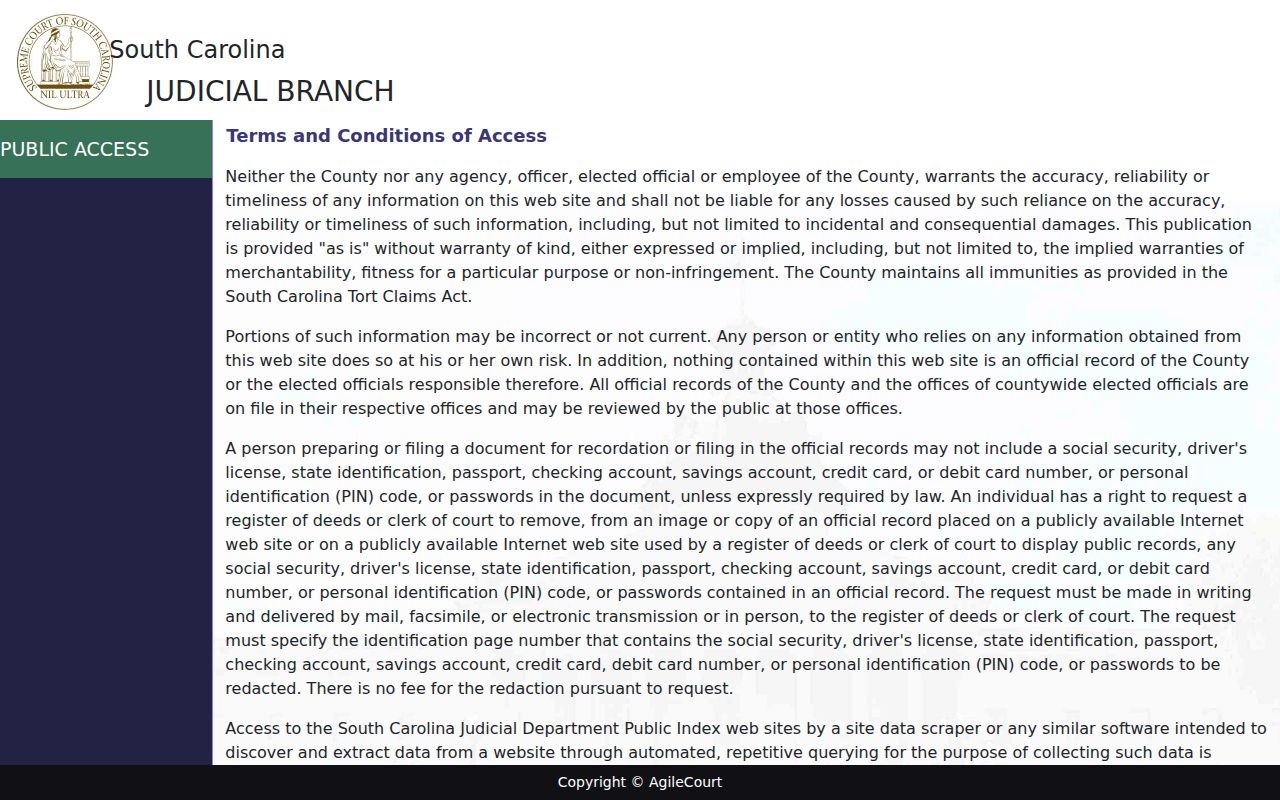
The portal is useful for a defined public docket question, while clerk access remains the documented alternative for record detail, copies, and matters the online display does not show.
Lexington Voter Records for a Resident Lookup
South Carolina separates a voter’s self-service screen from public inspection and list access. MySCVotes asks for county, first name, last name, date of birth, and the last four digits of the Social Security number, then directs the voter to enter information as it appears on the registration card. It is an identity-authenticated self-service channel, not a general stranger-name lookup. No result display was inspected, so none should be inferred from the login fields.
S.C. Code §7-5-410 makes official registration records inspectable by any citizen at the county board or clerk, while Social Security numbers are not public. The Lexington County Board of Voter Registration and Elections is the local custodian for an inspection request, correction question, or current district information. A registration record may show status, address, district context, and participation history. It never shows how a person voted.
Use the county elections office as the local route for record questions.
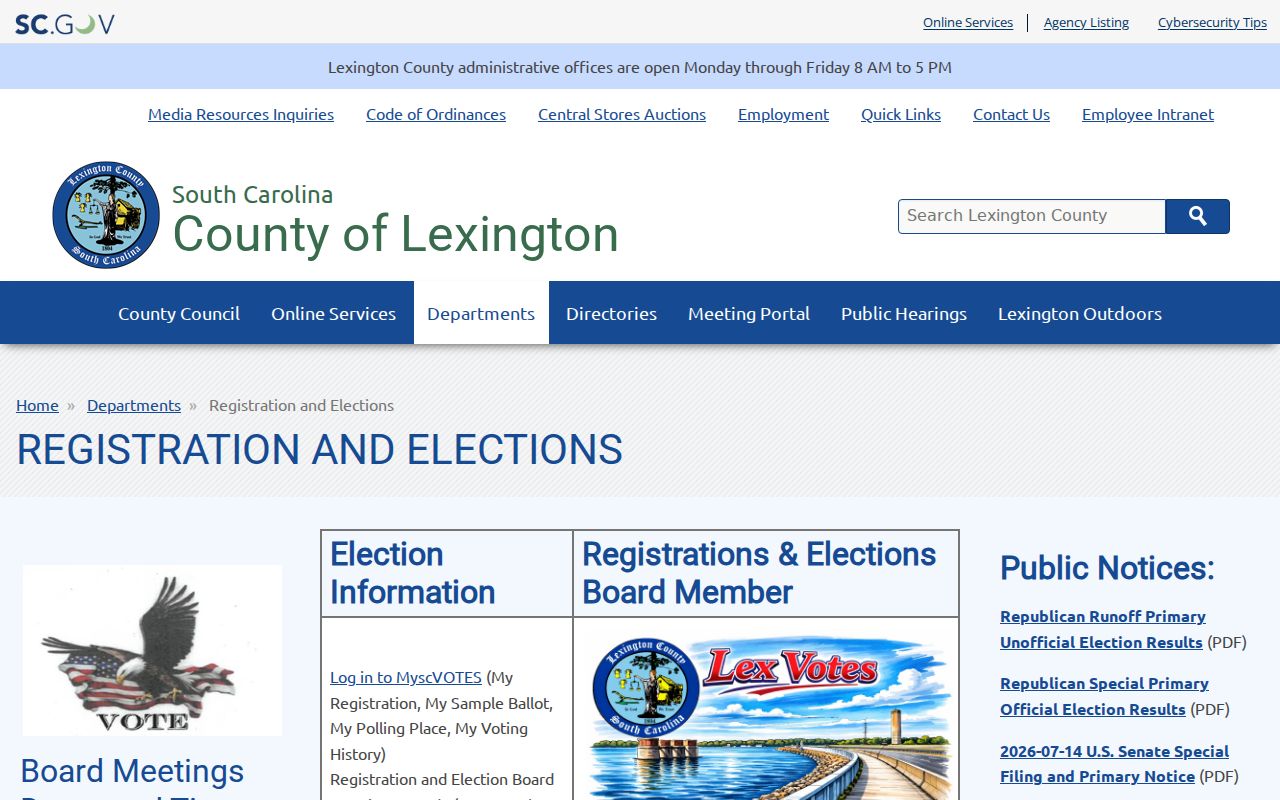
The office is the place to ask about public inspection procedures, instead of treating the self-service login as a public browse tool.
The State Election Commission’s voter-list sales process is a different, regulated channel. The purchaser must be a registered South Carolina voter under the cited statute. Available filters include county, voting district, age, sex, race, household, election participation, and registration date. Electronic files may include listed registration fields and participation in the prior two statewide primary or general elections, but never ballot choices. Its FOIA form also supports online, e-mail, fax, or mail submission for a defined request. Personal information from public bodies may not be used for commercial solicitation under §30-2-50.
State voter resources set out the statewide access route and related county-office help.
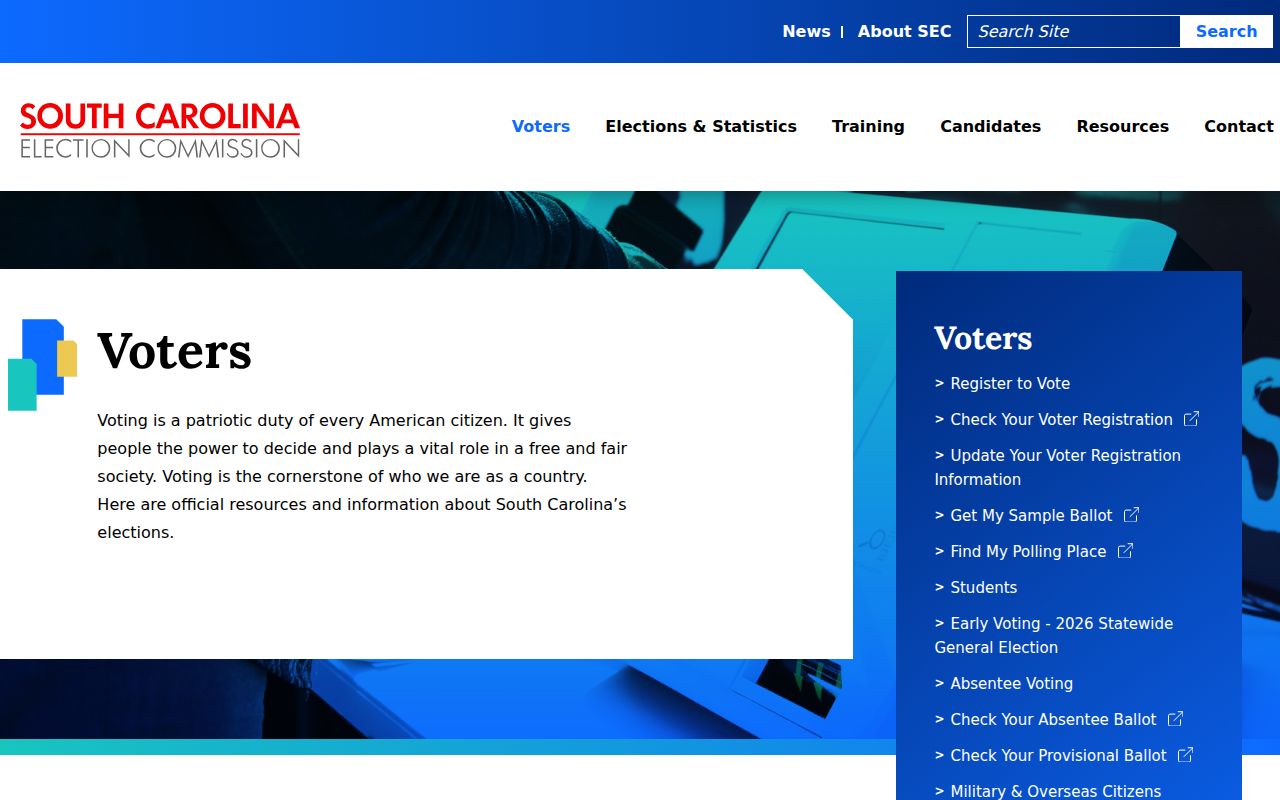
Use the channel that fits the question: authenticated self-service, local inspection, or the limited statutory list process.
Vital Records in a Lexington Resident Lookup
South Carolina DPH issues certificates for Lexington events, but a certificate is not a live-person directory. Birth records become public after 100 years and death records after 50 years, each as noncertified copies. Before those periods, Title 44, Chapter 63 sets statutory eligibility. DPH records births and deaths from 1915. For a historic lead, SCDAH offers death images more than 50 years old and online 1915-1919 birth records, while its research room can help identify archival holdings.
Request method matters. DPH documents mail requests, an approved online or phone vendor, and state-office or drop-off routes for qualifying vital requests. Birth and death mail requests use a completed form, photo ID, and a $12 nonrefundable search fee that includes a copy if found, with $3 for each additional copy; the documented expedited route is $17 plus $3 for additional copies and online vendor processing may apply. The DPH pages said in-person or drop-off service had been temporarily unavailable after June 19, 2025, so current availability should be verified before travel.
Marriage certificates at DPH cover July 1950 through December 2023. Contact the issuing Probate Court for earlier or later marriage records. DPH divorce reports cover July 1962 through December 2023, while the Clerk holds the actual decree where filed. A requester without eligibility may receive a statement of occurrence for marriage or divorce rather than a certificate. These boundaries come from S.C. Code §§44-63-80, 44-63-84, 44-63-86, and 44-63-110.
The South Carolina DPH Vital Records gateway identifies the official state custodian and request channels.
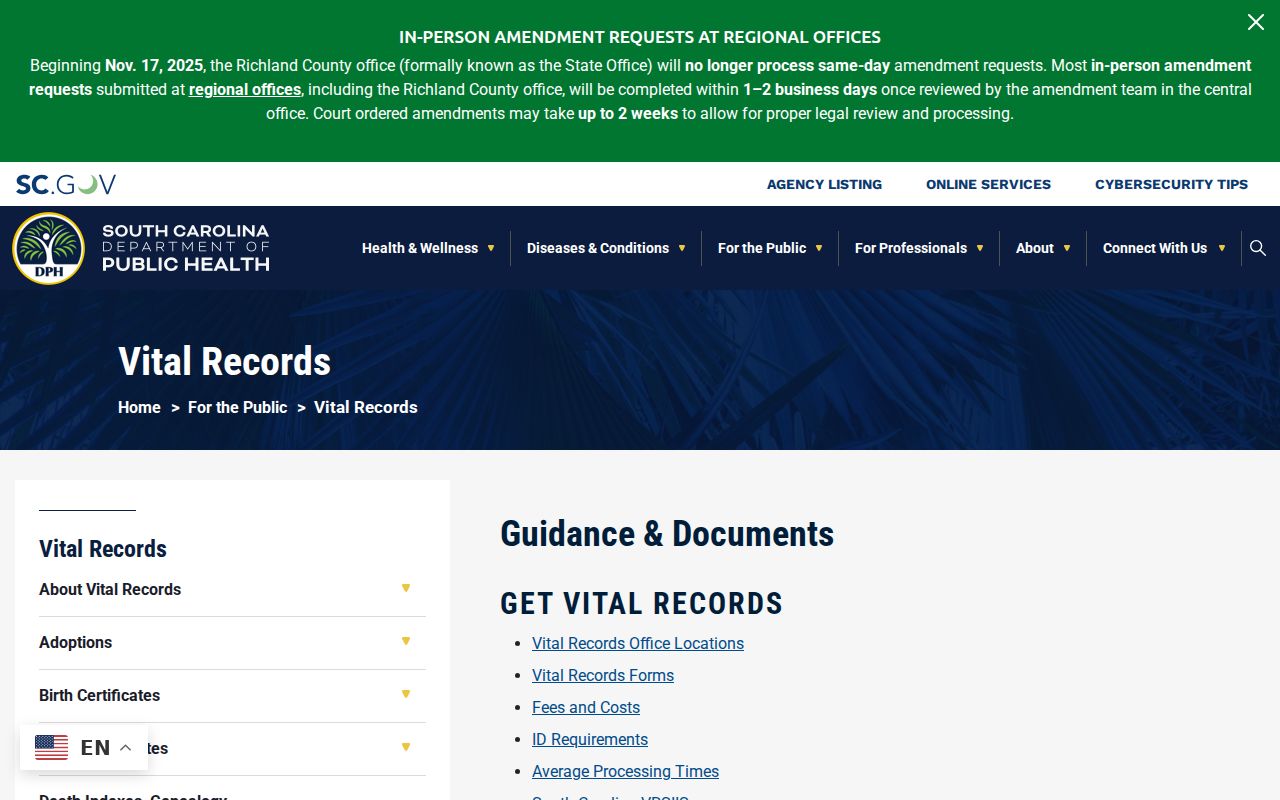
A vital record is best used to confirm the recorded event and the custodian’s access rule, not to make a claim about a living person’s current location.
Older Lexington Names in Resident Lookup Sources
The Lexington County Public Library obituary index is the stronger local name route for a historical question. Its search requires a last name and accepts an optional first name or nickname, year of death, or browse-by-year selection. Search names as they appear in a record and try documented variants. The service can lead to a historic notice, but it does not establish a current address or turn a family connection into proof. For a more complete family-history trail, the physical directory runs and microfilm are covered through the Lexington city directory collections.
A successful library obituary-index result has a specific inventory. It shows Full Name, death and birth dates, age or place, source code, and publication date and page. Open the cited newspaper issue or microfilm before relying on the notice text. Coverage is not continuous: the Lexington Dispatch-News branch has a documented gap from February 24, 1944 through October 4, 1962. Ask Lexington Main about the underlying newspapers for a date in that interval instead of treating an absent index hit as a negative finding.
For an heir question, start with an actual obituary or newspaper lead and request a specific estate file from Probate Court or the Clerk. Record only heirs named in the filing. For an adult adoptee or birth-parent question, DPH’s statutory consent route is not an open name search. These are intentionally narrow channels.
Lexington Resident Lookup Requests After Online Access
When an online result ends, ask for a defined public record from the custodian, not an open-ended request to identify someone. South Carolina FOIA, Title 30, Chapter 4, permits inspection, copying, or electronic transmission of a nonexempt public record. It does not require an agency to create an electronic record that does not exist. Give the office a name, date or year, address, TMS, case number, and record type where known. That precision also helps the custodian apply privacy and law-enforcement exemptions correctly.
For written requests, an agency generally determines availability within 10 business days for records under 24 months old and 20 business days for older records. Once nonexempt material will be provided, production is due within 30 calendar days, or 35 days for older material. A permitted deposit can move the production clock. The County FOIA form specifies a possible 25 percent nonrefundable deposit before research, plus listed copy and research charges. The Town’s current FOIA request portal moved to NextRequest on June 10, 2025; it is the documented route for Town administrative records that are subject to FOIA.
Town Municipal Court has no verified online public name portal. Contact the clerk for a specific file, or use the Town FOIA channel for a defined municipal administrative record when it is subject to FOIA. The Clerk, Probate Court, Assessor, Register of Deeds counter, library staff, and SCDAH research services are distinct fallbacks. Choose the one that keeps the requested record.
Note: A request for a record can be public, while a request asking an office to infer a person’s identity or residence may not be a record request at all.
Professional Records in a Lexington Resident Lookup
Professional, business, and facility systems can corroborate a public affiliation, not a home address. The South Carolina LLR Licensee Lookup is board-specific. Its medical form accepts optional last name, first name, license number, city, state code, and specialties; partial names work, and specialty requires city. Licensing pages say data updates nightly, while the board disclaimer says pending discipline is not shown and final status or discipline may not be current. Confirm a material point with the board.
The DPH Food Grades result inventory is another useful boundary. A result can show the official establishment name, facility street address, grade, map location, recent inspection dates, and report or PDF links within the three-year public window. Establishment, grade, facility type, street, city, county, and date filters limit the result set. It documents a permitted retail-food facility and its inspections. It does not identify a home address or establish who lives at the facility.
The LLR gateway is the official starting point for a public credential status check.
Use a credential result only for the license or affiliation it displays, then verify a current status directly with the relevant board.
Legal Limits on a Lexington Resident Lookup
South Carolina’s Family Privacy Protection Act protects important personal-information boundaries. Section 30-2-50 bars knowingly obtaining or using personal information from a state agency, local government, or political subdivision for commercial solicitation. A voter’s inactive-status request can remove that voter from active lists and online availability, but does not erase the underlying registration. DMV personal data and utility customer records are not general public lookup sources. A public record may be accurate while still giving no permission to contact, monitor, impersonate, or publish information to harm someone.
Targeted online-display protections began January 1, 2026 for eligible current or former law-enforcement personnel, corrections personnel, and judges. Under the cited Title 30 programs, a qualifying person can ask a particular agency to restrict a home address, personal cell number, and in applicable cases a TMS from publicly accessible online records. The protection is agency-specific and has exceptions. It does not erase every official record or create a universal opt-out from all data sources. A missing online image can require a custodian access check.
Be wary of unexpected demands tied to court, deed, or ROD records. Lexington County has warned about mail using a nonexistent “Lexington County Public Judgement Records” name, and the Sheriff says it does not collect traffic fines or warrants by prepaid card. Confirm a demand through an independently located official number before giving money or personal information. For an official record correction or redaction question, contact the custodian that holds the record.